
Original hypothetical scenario analysis
$10,000 Price Cut vs. $10,000 Seller Credit: What Changes for the Buyer?
The same dollar offer can change different parts of a purchase. We compare three strategies to show what happens to upfront cash, mortgage payments, interest, and the balance still owed.
The short answer: less cash now and less debt are different results
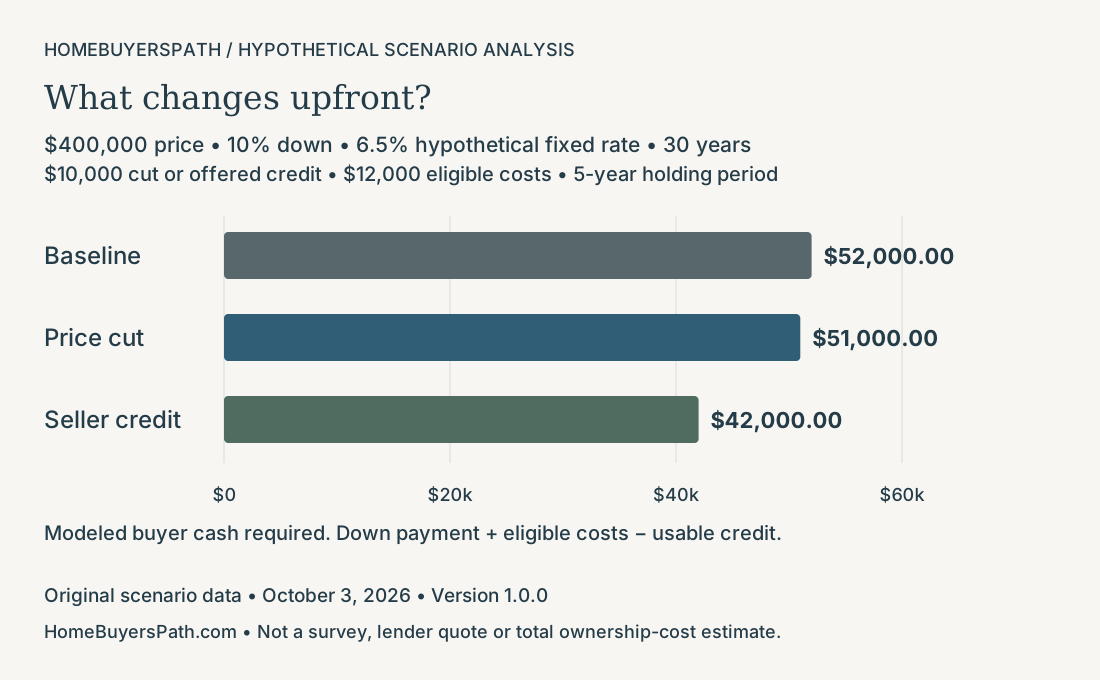
In our main example, a fully usable seller credit lowers modeled upfront cash from $52,000.00 to $42,000.00. A price cut lowers it to $51,000.00 and reduces monthly principal and interest by $56.89.
The credit leaves the purchase price and starting mortgage unchanged. The price cut reduces the mortgage by $9,000.00 because this buyer puts 10% down. After five years, that smaller mortgage has a lower remaining balance.
The credit may leave more savings available at closing; the price cut means financing less. The credit that can actually be used, the loan terms, the holding period, and the buyer's priorities all affect the comparison. The calculations do not select a winner.
One controlled comparison, with the assumptions in view
Each comparison starts with the same property and financing assumptions. We change the negotiated price or the applied seller credit while keeping the rate, term, down-payment percentage, eligible-cost amount, and holding period fixed.
- Original price
- $400,000.00
- Price cut / offered credit
- $10,000 / up to $10,000
- Down payment
- 10% of each strategy's price
- Hypothetical study rate
- 6.5% fixed; not a current market quote
- Mortgage term
- 30 years, fully amortizing
- Eligible closing/prepaid costs
- $12,000.00 before this seller credit
- Main holding period
- 5 years of scheduled payments
- Appraisal and other financing
- Sufficient appraisal; no second loan or other credits
The property is assumed to appraise sufficiently for the original price and financing. The price-cut strategy uses a genuinely lower contract price. We do not assume an inflated price to manufacture a credit, a refinance during the holding period, or any seller agreement beyond the hypothetical scenario.
The $12,000 cost input is chosen for this illustration. It is not a typical-cost claim or a universal percentage of purchase price. We hold it constant even though real transaction costs can change with the loan, property, closing date, and lender.
A seller credit does not buy a lower rate in this study. Points and temporary or permanent buydowns require their own pricing and rules, so they are excluded. Fannie Mae's buydown guidance and CFPB's explanation of points and lender credits describe those separate arrangements.
What changes at the $400,000 purchase?
The baseline has no special price cut or seller credit. The price-cut strategy reduces the price to $390,000. The seller-credit strategy keeps the $400,000 price and applies $10,000 to the modeled eligible costs.
| Modeled figure | Baseline | Price cut | Seller credit |
|---|---|---|---|
| Purchase price | $400,000.00 | $390,000.00 | $400,000.00 |
| Down payment (10%) | $40,000.00 | $39,000.00 | $40,000.00 |
| Starting loan | $360,000.00 | $351,000.00 | $360,000.00 |
| Eligible costs before credit | $12,000.00 | $12,000.00 | $12,000.00 |
| Seller credit applied | $0.00 | $0.00 | $10,000.00 |
| Modeled buyer cash required | $52,000.00 | $51,000.00 | $42,000.00 |
| Monthly principal & interest | $2,275.44 | $2,218.56 | $2,275.44 |
Headline hypothetical scenario: 10% down, 6.5% fixed, 30 years, $12,000 eligible costs.
Baseline
- Purchase price
- $400,000.00
- Down payment (10%)
- $40,000.00
- Starting loan
- $360,000.00
- Eligible costs before credit
- $12,000.00
- Seller credit applied
- $0.00
- Modeled buyer cash required
- $52,000.00
- Monthly principal & interest
- $2,275.44
Price cut
- Purchase price
- $390,000.00
- Down payment (10%)
- $39,000.00
- Starting loan
- $351,000.00
- Eligible costs before credit
- $12,000.00
- Seller credit applied
- $0.00
- Modeled buyer cash required
- $51,000.00
- Monthly principal & interest
- $2,218.56
Seller credit
- Purchase price
- $400,000.00
- Down payment (10%)
- $40,000.00
- Starting loan
- $360,000.00
- Eligible costs before credit
- $12,000.00
- Seller credit applied
- $10,000.00
- Modeled buyer cash required
- $42,000.00
- Monthly principal & interest
- $2,275.44
Upfront cash: the down payment explains the difference
A $10,000 price cut reduces this buyer's down payment by $1,000.00 and the loan by $9,000.00. Only the down-payment reduction changes our upfront cash figure, because costs before credit stay fixed.
The usable credit instead offsets $10,000.00 of the $12,000 eligible amount. It leaves $2,000.00 of those costs for the buyer, in addition to the $40,000.00 down payment. Compared with the price cut, the credit requires $9,000.00 less modeled cash at this closing.
Monthly P&I: the smaller loan changes the payment
The price cut lowers monthly P&I from $2,275.44 to $2,218.56. The seller-credit payment stays at $2,275.44 because its loan, rate, and term match the baseline.
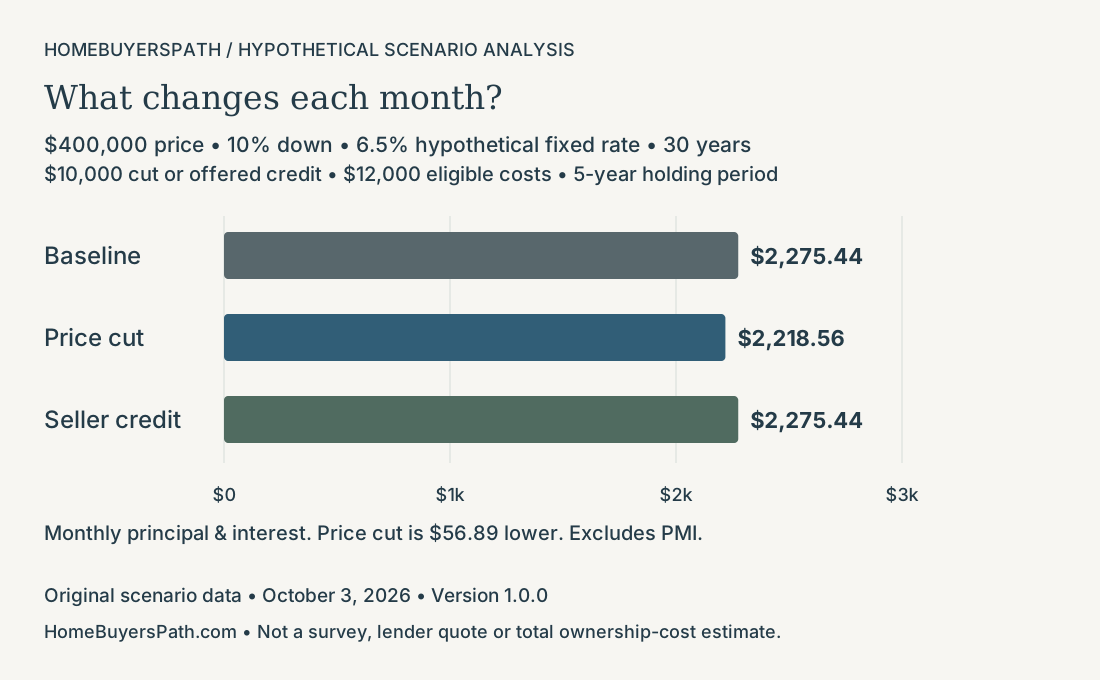
Dividing the upfront-cash difference by the monthly-payment difference may look like a simple break-even calculation. It leaves out the different loan balances. A payment comparison alone cannot tell you which strategy leaves you in the same financial position at a future date.
After five years: separate interest from principal and debt still owed
After 60 scheduled payments, the price-cut mortgage has $328,574.53 remaining. The baseline and seller-credit mortgages each have $336,999.52 remaining: $8,424.99 more debt than the price-cut case.
| Modeled figure | Baseline | Price cut | Seller credit |
|---|---|---|---|
| P&I paid over five years | $136,526.69 | $133,113.53 | $136,526.69 |
| Principal paid over five years | $23,000.48 | $22,425.47 | $23,000.48 |
| Interest paid over five years | $113,526.21 | $110,688.06 | $113,526.21 |
| Remaining loan balance | $336,999.52 | $328,574.53 | $336,999.52 |
| Modeled upfront cash + five years of P&I | $188,526.69 | $184,113.53 | $178,526.69 |
| Modeled price + interest + net eligible costs | $525,526.21 | $512,688.06 | $515,526.21 |
Five-year headline results. Unrounded mortgage calculations; amounts shown to cents.
Baseline
- P&I paid over five years
- $136,526.69
- Principal paid over five years
- $23,000.48
- Interest paid over five years
- $113,526.21
- Remaining loan balance
- $336,999.52
- Modeled upfront cash + five years of P&I
- $188,526.69
- Modeled price + interest + net eligible costs
- $525,526.21
Price cut
- P&I paid over five years
- $133,113.53
- Principal paid over five years
- $22,425.47
- Interest paid over five years
- $110,688.06
- Remaining loan balance
- $328,574.53
- Modeled upfront cash + five years of P&I
- $184,113.53
- Modeled price + interest + net eligible costs
- $512,688.06
Seller credit
- P&I paid over five years
- $136,526.69
- Principal paid over five years
- $23,000.48
- Interest paid over five years
- $113,526.21
- Remaining loan balance
- $336,999.52
- Modeled upfront cash + five years of P&I
- $178,526.69
- Modeled price + interest + net eligible costs
- $515,526.21
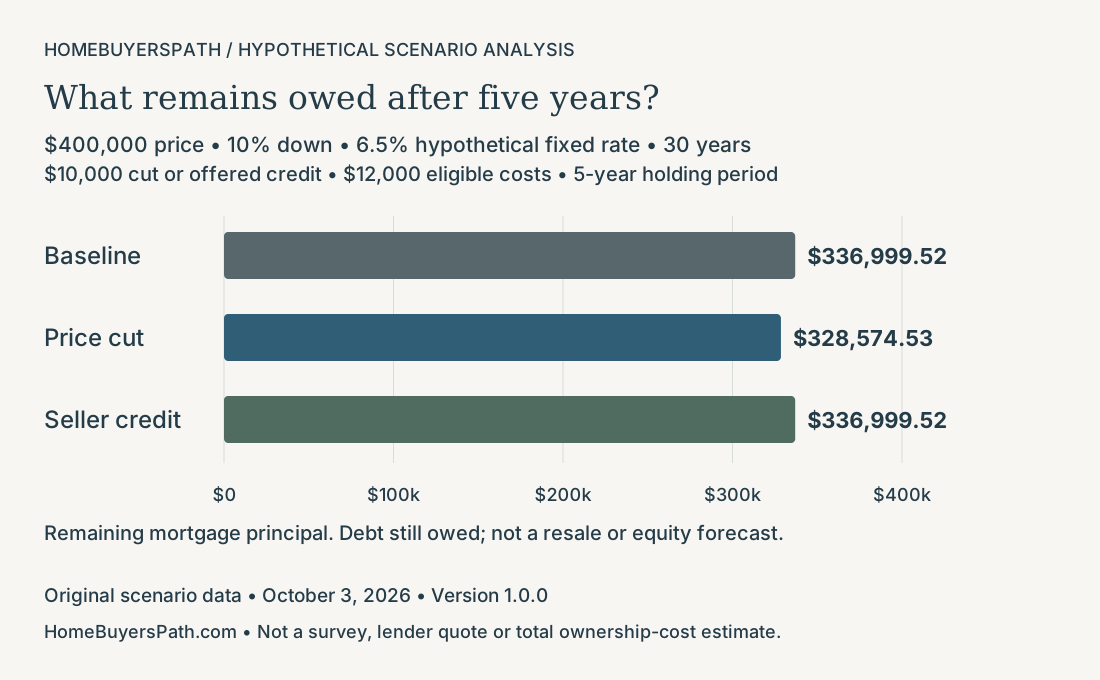
Principal paid reduces the debt. Interest is the charge for borrowing. The credit and baseline have the same amortization, while the smaller price-cut loan has both lower interest paid and lower principal paid in dollars. Lower principal paid alone does not mean a worse result; that buyer also started with less debt.
One broader measure, with a narrow meaning
Modeled price + interest + net eligible costs adds the strategy's purchase price, interest through the selected period, and eligible costs after seller credit. Equivalently, it adds modeled upfront cash, P&I paid through that period, and the remaining mortgage balance.
For the headline example, this measure is $512,688.06 for the price cut and $515,526.21 for the seller credit, a difference of $2,838.16. Here the full cut and full credit reduce price-plus-net-costs by the same $10,000; the remaining difference comes from interest on the larger mortgage.
This is not all cash already paid, and it is not total ownership cost. It includes debt still outstanding, omits the home's value and resale costs, and does not discount future money. It cannot value the flexibility of retained cash, investment returns, tax effects, or personal priorities.
An offered $10,000 credit may not be usable in full
The calculation needs three separate numbers: the amount offered, the eligible costs available to absorb it, and the contribution ceiling under the model. The smallest controls the amount applied.
Enough costs and allowance
$400,000 price · 10% down · $12,000 eligible costs
- Credit offered
- $10,000.00
- Eligible amount
- $12,000.00
- Percentage-based ceiling
- $24,000.00
- Maximum usable under assumptions
- $12,000.00
- Credit applied
- $10,000.00
- Offer not provided
- $0.00
Only $6,000 eligible costs
$400,000 price · 10% down · $6,000 eligible costs
- Credit offered
- $10,000.00
- Eligible amount
- $6,000.00
- Percentage-based ceiling
- $24,000.00
- Maximum usable under assumptions
- $6,000.00
- Credit applied
- $6,000.00
- Offer not provided
- $4,000.00
Contribution ceiling binds
$300,000 price · 5% down · $12,000 eligible costs
- Credit offered
- $10,000.00
- Eligible amount
- $12,000.00
- Percentage-based ceiling
- $9,000.00
- Maximum usable under assumptions
- $9,000.00
- Credit applied
- $9,000.00
- Offer not provided
- $1,000.00
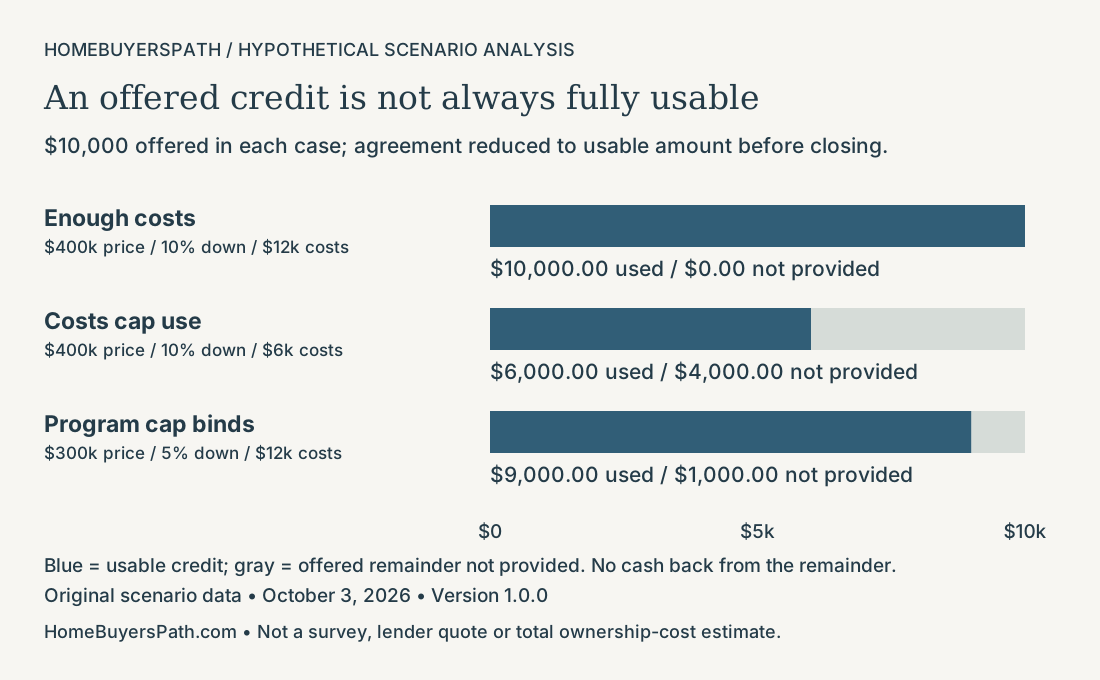
Real closing refunds and tax prorations have their own rules. Our statement concerns the unused seller offer in this model; it does not mean a buyer can never receive a legitimate refund at closing. Fannie Mae purchase-transaction guidance.
Which contribution rules does the model use?
Fannie Mae's standard principal-residence financing-concession ceiling is 3% above 90% LTV/CLTV, 6% at 75.01%–90%, and 9% at 75% or below. The percentage applies to the lower of sale price and appraisal, not the mortgage amount. Eligible closing costs provide another ceiling. Current Fannie Mae IPC guidance.
There is no second loan, so CLTV equals LTV. Keeping the down-payment percentage fixed keeps the price-cut strategy in the same band. A lower price reduces the dollar base of a contribution ceiling, but this study does not combine a cut and credit in one strategy. Fannie Mae CLTV definition.
Contributions cannot satisfy down payment or required reserves. Local customary seller-paid charges and other exceptions mean this is not a cap on everything a seller pays. We exclude other interested-party contributions, special programs, gifts of equity, HOA subsidies, and buydowns. Second homes, investment properties, FHA, VA, USDA, and jumbo loans are outside V1.
The tool accepts at least 5% down and starting loans up to $832,750.00, the FHFA 2026 one-unit baseline conforming limit. These are model boundaries, not universal eligibility rules: higher conforming limits exist in some places, and some programs allow smaller down payments.
Allowed prepaids and initial escrow may be part of the eligible amount, but are not interchangeable fees. The current IPC chapter does not list older prepaid-interest and insurance month caps. Escrow still requires a lender's account analysis; the RESPA cushion limit is not a two-month cap on the entire initial deposit. The tool does not calculate escrow or approve charges as eligible.
What changes across the other hypothetical scenarios?
The main dataset contains 27 comparisons: $300,000, $400,000, and $500,000 prices; 5%, 10%, and 20% down; and 1-, 5-, and 10-year holding periods. Three strategies per comparison produce 81 primary rows. One additional $6,000-cost comparison brings the download to 84 rows.
At $300,000 and 5% down, the ceiling is $9,000.00, so $1,000.00 of the offer is not provided. The other main combinations can absorb the full $10,000 because their ceilings and $12,000 eligible costs are sufficient. The holding period does not change what is available at closing.
A $10,000 cut reduces the dollar down payment by $500 at 5% down, $1,000 at 10%, and $2,000 at 20%. The corresponding loan reductions are $9,500, $9,000, and $8,000. With one rate and term, these loan differences drive the P&I differences, even when the original price changes.
Keep the headline purchase; change only the holding period
1 year
- Price-cut interest paid
- $22,699.49
- Seller-credit interest paid
- $23,281.53
- Price-cut remaining debt
- $347,076.78
- Seller-credit remaining debt
- $355,976.19
5 years
- Price-cut interest paid
- $110,688.06
- Seller-credit interest paid
- $113,526.21
- Price-cut remaining debt
- $328,574.53
- Seller-credit remaining debt
- $336,999.52
10 years
- Price-cut interest paid
- $212,791.26
- Seller-credit interest paid
- $218,247.44
- Price-cut remaining debt
- $297,564.20
- Seller-credit remaining debt
- $305,194.05
Longer periods accumulate more interest; they do not retroactively change the upfront-cash difference. A refinance, extra principal payment, or sale would create a different path from this scheduled-payment model.
View the nine price-and-down-payment combinations at five years
$300,000.00 · 5% down
- Seller credit applied
- $9,000.00
- Upfront cash, price cut
- $26,500.00
- Upfront cash, seller credit
- $18,000.00
- Monthly P&I reduction from cut
- $60.05
- Remaining debt, price cut
- $257,898.24
- Remaining debt, seller credit
- $266,791.29
$300,000.00 · 10% down
- Seller credit applied
- $10,000.00
- Upfront cash, price cut
- $41,000.00
- Upfront cash, seller credit
- $32,000.00
- Monthly P&I reduction from cut
- $56.89
- Remaining debt, price cut
- $244,324.65
- Remaining debt, seller credit
- $252,749.64
$300,000.00 · 20% down
- Seller credit applied
- $10,000.00
- Upfront cash, price cut
- $70,000.00
- Upfront cash, seller credit
- $62,000.00
- Monthly P&I reduction from cut
- $50.57
- Remaining debt, price cut
- $217,177.47
- Remaining debt, seller credit
- $224,666.35
$400,000.00 · 5% down
- Seller credit applied
- $10,000.00
- Upfront cash, price cut
- $31,500.00
- Upfront cash, seller credit
- $22,000.00
- Monthly P&I reduction from cut
- $60.05
- Remaining debt, price cut
- $346,828.67
- Remaining debt, seller credit
- $355,721.71
$400,000.00 · 10% down
- Seller credit applied
- $10,000.00
- Upfront cash, price cut
- $51,000.00
- Upfront cash, seller credit
- $42,000.00
- Monthly P&I reduction from cut
- $56.89
- Remaining debt, price cut
- $328,574.53
- Remaining debt, seller credit
- $336,999.52
$400,000.00 · 20% down
- Seller credit applied
- $10,000.00
- Upfront cash, price cut
- $90,000.00
- Upfront cash, seller credit
- $82,000.00
- Monthly P&I reduction from cut
- $50.57
- Remaining debt, price cut
- $292,066.25
- Remaining debt, seller credit
- $299,555.13
$500,000.00 · 5% down
- Seller credit applied
- $10,000.00
- Upfront cash, price cut
- $36,500.00
- Upfront cash, seller credit
- $27,000.00
- Monthly P&I reduction from cut
- $60.05
- Remaining debt, price cut
- $435,759.10
- Remaining debt, seller credit
- $444,652.14
$500,000.00 · 10% down
- Seller credit applied
- $10,000.00
- Upfront cash, price cut
- $61,000.00
- Upfront cash, seller credit
- $52,000.00
- Monthly P&I reduction from cut
- $56.89
- Remaining debt, price cut
- $412,824.41
- Remaining debt, seller credit
- $421,249.40
$500,000.00 · 20% down
- Seller credit applied
- $10,000.00
- Upfront cash, price cut
- $110,000.00
- Upfront cash, seller credit
- $102,000.00
- Monthly P&I reduction from cut
- $50.57
- Remaining debt, price cut
- $366,955.03
- Remaining debt, seller credit
- $374,443.91
These price points are illustrative. Their frequency in this small grid says nothing about the prevalence of an outcome among U.S. homebuyers.
Methodology: how to reproduce every row
Let P be original price, D the price cut, d the down-payment percentage divided by 100, C eligible costs, O offered credit, and q the applicable contribution-limit percentage.
1. Price, down payment, and starting mortgage
Strategy price S = P for baseline/credit; S = P − D for price cut.
Down payment = S × dStarting loan L = S × (1 − d)
2. Contribution allowance and applied credit
Percentage ceiling = q × S, because the appraisal is assumed sufficient.
Maximum usable = min(C, q × S)Applied credit U = min(O, C, q × S)Offer not provided = O − U
O is zero for baseline and price cut. U assumes the unprovided portion is removed from the agreement before closing. Other contributions that might use part of the allowance are excluded.
3. Modeled cash requirement
Buyer cash = S × d + C − U
No earnest-money deduction, other credit, or settlement adjustment is included.
4. Fixed-rate payment
Let r = annual mortgage interest rate as a percentage ÷ 1,200, n = term years × 12, and k = holding years × 12. The rate is the note interest rate, not disclosed APR.
M = L × r ÷ (1 − (1 + r)−n)
At 0% interest, M = L ÷ n. M includes principal and interest only.
5. Remaining balance, principal, and interest
Bk = L × (1 + r)k − M × ((1 + r)k − 1) ÷ r
At 0%, Bk = L × (n − k) ÷ n. At k = 0 the balance is L; at k = n it is zero.
Principal paid = L − BkTotal P&I paid = k × MInterest paid = k × M − (L − Bk)
6. Totals with different meanings
Cash paid through period = buyer cash + k × M
Modeled price + interest + net eligible costs = S + interest paid + C − U
The second measure also equals buyer cash + k × M + Bk. Remaining debt is included once. Adding principal paid again would count it twice.
Precision, boundaries, and differences
Calculations retain internal floating-point precision and do not round every monthly payment to cents. Display and downloaded currency values are rounded to cents, so subtracting displayed figures can differ by a cent from a difference calculated before rounding. Real servicing schedules may round payments.
The remaining-balance implementation uses an algebraically equivalent expression arranged to reduce numerical cancellation near zero interest. It handles zero interest, zero elapsed years, and the end of the term explicitly. There are no payment changes or extra principal payments.
Down-payment inputs allow two decimal places. LTV follows the Fannie Mae rounding convention: truncate to two decimal places, then round up to a whole percent for underwriting. Integer percentage boundaries preserve the exact 90% and 75% bands here. The tool accepts 15-, 20-, or 30-year terms and whole-year holding periods no longer than the term.
Each delta is the named first strategy minus the second. Seller credit minus price cut is -$9,000.00 for headline buyer cash, $56.89 for monthly P&I, and $8,424.99 for debt remaining at five years. A negative cash difference means less modeled cash required; it is not a universal score.
Download the original scenario data
The free dataset contains 84 strategy rows: the 81-row primary matrix and three rows for the $6,000-cost case. It contains predefined hypothetical inputs only, not private calculator entries. No email signup is required.
Version 1.0.0 · Scenario generation date · Formulas in the methodology above.
Each row identifies the scenario and strategy, inputs, adjusted price, contribution limit and utilization, down payment, mortgage, P&I, modeled cash, principal and interest paid, remaining balance, and aggregate measures. The four charts use these predefined scenarios.
What the comparison cannot tell you
- Whether the transaction qualifies. Eligible costs, competing contributions, property value, lender requirements, and program rules require review. The calculator is not a preapproval or underwriting decision.
- Your complete payment or ownership cost. Recurring taxes, homeowners insurance, PMI, HOA, repairs, and maintenance are omitted. Allowed upfront prepaids or escrow may be included in C; that does not add ongoing bills to the payment model.
- Your mortgage-insurance outcome. Keeping the down-payment percentage fixed means these scenarios do not cross the 80% LTV boundary. Actual premiums can still differ with loan amount and pricing. Fixed-dollar down payments and financed premiums are not modeled.
- The best use of retained cash. Emergency savings, investment returns, inflation, tax deductions, future home value, sale proceeds, and opportunity cost are not valued. We do not predict a refinance or discount future cash flows.
- What a seller will accept. Contract wording, negotiation, timing, and circumstances matter. The unused-credit assumption requires agreement; it does not rewrite a contract.
- Your actual closing transfer. The Loan Estimate, Closing Disclosure, and settlement accounting can include deposits, prorations, paid-ahead amounts, and adjustments absent here. Confirm the amount due with your lender and settlement team.
This educational analysis is not tax, legal, or lending advice. It isolates a tradeoff so buyers can ask more precise questions; it does not replace transaction-specific review.
Try the tradeoff with different assumptions
Change the price, cut, credit offered, down payment, rate, term, eligible costs, and holding period. Compare the baseline with both alternatives, including what cannot be used.
Compare a seller credit and price cut →When you have lender forms, use Compare Two Loan Estimates to examine actual offers. For upfront categories, see prepaids versus escrow.
Official sources and access date
Sources checked October 3, 2026, in America/Denver. The dates below belong to the source pages. Hypothetical prices and rates were selected for this study, not taken from these sources as market statistics.
- Fannie Mae B3-4.1-02: Interested Party Contributions — May 7, 2025 chapter; uses, ceilings, and exclusions.
- Fannie Mae: Excess Interested Party Contributions — official DU example; no publication date displayed.
- Fannie Mae B2-1.2-01: LTV Ratios — June 1, 2022; value base and rounding.
- Fannie Mae B2-1.2-02: CLTV Ratios — December 4, 2018; subordinate financing.
- Fannie Mae B2-1.3-01: Purchase Transactions — November 5, 2025; refunds and program requirements.
- Fannie Mae B2-1.4-04: Temporary Interest Rate Buydowns — August 7, 2024; separate buydown requirements.
- CFPB: Closing Disclosure Explainer — last modified October 10, 2023; payment and closing categories.
- CFPB: Lender Credits and Points — reviewed October 19, 2023; rate and upfront-cost tradeoffs.
- CFPB Regulation X, § 1024.17(c): Escrow Accounts — current regulation at access; escrow analysis and cushion limits.
- FHFA: 2026 Conforming Loan Limit Values — November 25, 2025 release; baseline limit.