
The Second Look
Compare the homes.
Keep the evidence.
The tours are over. The rooms are starting to blur together. Before choosing a favorite, separate what you need, what you prefer, and what you still do not know.
Watch / The Second Look
See the three choices side by side.
A short walkthrough of the fictional case, the evidence to keep, and the question to ask next.
4 minutes 48 seconds · English captions are visible in the video; an optional caption track is also available in the player. AI narration. Playback starts when you press Play.
The fictional case
Three tours. One firm requirement.
For this buyer, an existing separate room with a closing door and enough usable space for their desk is a must-have for daily home working.
The favorite kitchen.
Observed: appealing kitchen and outdoor space; an open-plan layout with no separate room that meets the requirement.
Does not meet this must-have
Can the preferences make up for it?
Not under the buyer’s current rule. A favorite kitchen does not create the required room. The buyer can consciously reconsider their requirement, but should not let an attractive feature quietly erase it.
The unverified study.
Listed, not observed: a study appears in the description, but the room was inaccessible during the tour. The rest of the layout felt promising.
Unknown until checked
What would turn “maybe” into evidence?
Arrange access. Check that the room is separate, that its door closes, and that its dimensions fit the buyer’s actual work setup. A listing label alone does not settle those questions.
The room that fits.
Observed and recorded: a separate room with a closing door and usable dimensions for this buyer’s desk. Outdoor space and the commute were less appealing.
This requirement is met
Does that make Cedar the winner?
No. Cedar clears this one requirement. It remains a candidate while the buyer checks costs, condition, documents, and other priorities. Meeting one must-have is not a recommendation to buy.
Alder, Birch, and Cedar are invented homes. Cost and condition information is incomplete for all three. These cards test one stated requirement, not overall quality, value, affordability, or readiness to make an offer.
Before the ratings
Write the rule before picking the favorite.
A useful must-have is specific enough to check. “A good place to work” leaves room for three different interpretations. “An existing separate room with a closing door and usable space for my desk” gives this buyer something to observe and measure.
Keep must have now, would like, and could change later separate. A bright kitchen may matter greatly without being a requirement. A possible conversion belongs in a future plan until its feasibility, permissions, cost, and timing are established.
Apply the same requirement to every home. You can change your mind after seeing the trade-offs. Write down the new rule and why it changed, then revisit all candidates under that rule. Otherwise, your favorite can quietly receive a different test.
Keep it and remove Alder from this shortlist, or deliberately reconsider it. Adding preference points does not supply the missing room.
Ratings can help organize preferences once their meaning is clear. Keep unresolved requirements and important concerns beside any score. A high total cannot verify an inaccessible room or answer a condition question.
Keep the source attached
“I saw it” and “the listing says it” are different notes.
Record the tour date and the evidence while it is fresh. These three labels help you see what a comparison actually rests on:
- Observed
- What you personally saw or measured. For Cedar: a separate room, a closing door, and recorded usable dimensions.
- Reported
- What a listing, person, or document says. Keep the source and date. For Birch: the listing describes a study.
- Not verified
- What remains unsettled. For Birch: whether the inaccessible room has the needed door and usable space.
One feature can have both a reported claim and an unanswered question. Do not force it into “yes” to complete a row. Write the question that would resolve it: “Can we access the study and record its door and dimensions?”
A tour observation has limits. Seeing a room does not establish its legal use, hidden construction condition, or future repair costs. Record concerns without diagnosing them, and seek the relevant documents or qualified help.
Compare the same scope
A lower price is only one part of the cost picture.
Keep the property comparison and the financing assumptions consistent. If one estimate uses a different down payment, loan term, or interest-rate assumption, label that difference before comparing payments. Principal and interest alone do not represent every homeownership cost.
Ongoing costs
Gather property-specific taxes, insurance quotes, applicable mortgage insurance and association charges, utilities, and maintenance assumptions.
One-time cash needs
Keep closing, moving, setup, and known repair costs separate. Record what is included, the source, and when payment would be due.
The CFPB recommends checking property-tax estimates and obtaining accurate insurance pricing in its Loan Estimate explainer. A previous owner’s bill or an early estimate deserves a check for your situation.
Mark missing amounts as not yet estimated. A blank is not zero. Avoid counting taxes or insurance twice when they already appear in an estimated payment. Keep maintenance allowances and individual repair estimates from overlapping too.
Use the free household budget check for ongoing income and spending, and the cash-planning path for purchase cash. Costs can change; neither a preference score nor this guide establishes affordability.
Leave with an action
Turn the unknown into a follow-up someone can answer.
“Look into the study” is easy to postpone. A useful follow-up names the question, who can help, the evidence needed, and a date to check back. Use the same structure for each home.
Birch / Next-look note
- Question
- Does the study meet the room requirement?
- Arrange with
- The agent or person coordinating access.
- Evidence needed
- View the room, check the door, and record usable dimensions against the desk setup.
- Review point
- Agree a follow-up date; leave the status unknown until checked.
Birch could become another candidate after verification. Cedar already clears this room requirement, but still needs the normal cost, condition, financing, property-document, and contract review. That is why this exercise ends with a clearer next action, rather than an automatic winner.
For condition questions, the CFPB recommends an independent home inspection; an appraisal serves a different purpose. Ask about specialist review where appropriate. Your purchase contract and local circumstances govern deadlines and available options, so work with your professional team. A second tour does not replace that work.
Free / Two printable pages
Bring a record.
Leave with a next step.
The Second Look worksheet gives you space to capture one tour while it is fresh, then compare three homes on a follow-up board. Record requirements, evidence, preferences, missing costs, and the next question.
Get the Second Look worksheet →Printable PDF for handwritten notes · No signup or purchase
- Page 1After-tour capture
One home. A dated record of what you know and what remains open.
- Page 2Three-home follow-up board
Compare the evidence and choose the action that could change your shortlist.
Optional paid toolkit
Want your comparisons in one workbook?
The $8.99 Homebuyer Decision Toolkit includes a home-comparison worksheet for up to three homes. Your ratings and importance weights organize personal fit; read concerns and dealbreakers alongside the score.
It requires desktop Microsoft Excel, sold separately. The free Second Look worksheet is a separate post-tour record. No purchase is needed to use this guide or its printable.
Preview the real toolkit worksheets →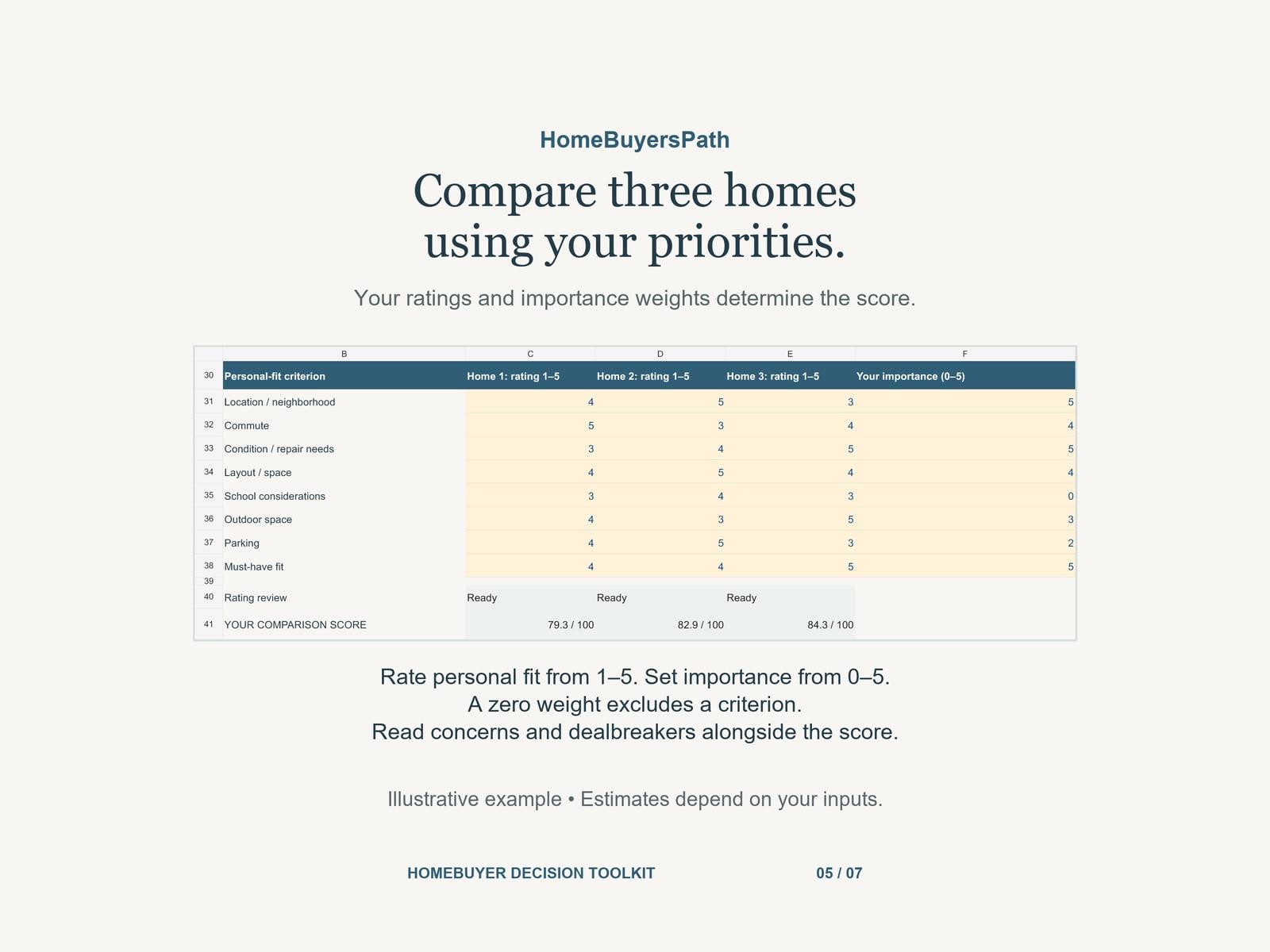
Full video transcript
The narration is reproduced below in all 12 chapters. Read at your own pace, or download the plain-text transcript.
0:00
A second look
Three homes. One beautiful kitchen. And a decision that still feels tangled. When you compare homes after a tour, the most useful first step is not a bigger scorecard. It is separating three things: what the home must provide, what you prefer, and what you still need to verify.
0:18
Name the requirement
Let's follow one fictional buyer. They work from home every day. Before comparing the properties, they choose a present-day requirement: an existing separate room, with a closing door, and enough usable space for their desk. They would also like a brighter kitchen, more outdoor space, and an easier commute. Those are preferences. They answer a different question.
0:41
Alder: attractive, but different
Alder has their favorite kitchen and outdoor space. But the layout they viewed has no separate room that meets the requirement. The appealing features are real. They simply do not create the missing room. Alder does not meet the stated requirement. The buyer can remove it from this shortlist, or deliberately reconsider the requirement and record the trade-off.
1:04
Birch: a label is not evidence
Birch is advertised with a study, but that room was inaccessible during the tour. The buyer has not checked its door or usable dimensions. So the answer is not yes. It is also not automatically no. It is unknown. The next step is specific: arrange access, check the door, and record whether the usable dimensions fit the desk.
1:27
Cedar: one requirement met
At Cedar, the buyer observed a separate room with a closing door and recorded dimensions that fit their desk. Cedar meets this particular requirement. It remains a candidate, even though the outdoor space and commute are less appealing. That does not make it the winner. Costs, condition, financing, property documents, and contract questions still need their own review.
1:51
Keep the three answers separate
Now compare the same question across all three homes. Alder does not meet it. Birch is not verified. Cedar meets it and remains a candidate. This is already more useful than trying to make every difference disappear into one number. Birch may become another candidate after a second visit. An unanswered question should not silently become a zero, a yes, or a failure.
2:16
Write what you know
After each tour, make three kinds of notes. Observed: what you actually saw or measured. Reported: what a listing, document, or person said, with the source and date. Not verified: what still needs checking. 'Study in the listing' and 'room measured during the visit' are different evidence. Keeping those labels makes your next conversation much more useful.
2:40
Give unknowns a next action
For each important unknown, write the question, who or what could answer it, and when you will follow up. For Birch, that means arranging access to the study. For a condition concern, it may mean an independent inspection or a specialist. A tour is not a substitute for those assessments. Ask your professional team how your contract and deadlines affect the next step.
3:04
Compare more than the price
Keep the money questions alongside the property notes. An asking price or a principal-and-interest estimate is not the complete cost of living there. Collect property-specific taxes and insurance estimates, any applicable mortgage insurance or association charges, utilities, and maintenance or known repair information. Separate monthly costs from one-time costs and cash needed. Mark missing estimates instead of treating blanks as zero.
3:32
A score starts a conversation
Preference ratings can help you compare trade-offs, especially when several homes meet your essential needs. But the result depends on the priorities and ratings you enter. A high score cannot verify an inaccessible room, resolve an inspection concern, or make an unaffordable payment comfortable. Read the concerns and dealbreakers beside the score. Keep the evidence visible.
3:56
Take the field worksheet
The free Second Look worksheet gives you a place to do this. Use the first page after a tour to capture one home's evidence and questions. Use the second to compare your shortlist and plan follow-ups. The accompanying guide walks through Alder, Birch, and Cedar with quick self-checks. Read the guide or watch the walkthrough at your own pace. No account or purchase is needed.
4:20
Keep the next step useful
If you want to organize several homes and mortgage offers in one workbook, the optional paid Homebuyer Decision Toolkit has real worksheet previews on the site. It requires desktop Microsoft Excel, sold separately. For now, take one useful step: name your requirement, label the evidence, and write the next question. Visit HomeBuyersPath dot com, open Guides, and choose The Second Look.
Sources and method
Reviewed November 17, 2026. This is HomeBuyersPath’s original decision-organizing lesson and fictional case. It does not inspect a property, value a home, approve financing, or recommend a purchase.
- CFPB: Schedule a home inspection — independent inspections, appraisals, and contract-dependent options.
- CFPB: Figure out how much you want to spend — the broader costs of owning a home.
- CFPB: Loan Estimate explainer — checking tax estimates and insurance pricing.